How to stop a cat from scratching furniture is one of the most common questions in any cat household — and one answer has to be ruled out before anything else: declawing. Declawing is abuse. It is the amputation of a cat’s toes, it is illegal in much of the world, and no scratched sofa justifies it.
A cat that shreds the arm of a sofa is not being spiteful, and it is not doing it to get even for being left alone. Scratching is a normal behaviour with a physical purpose, and it happens in the places a cat has decided matter most — which, unfortunately, is usually the furniture you care about.
The good news is that this is one of the most solvable behaviour problems in a cat household, and it does not require punishment — and it never requires surgery. It requires getting four things right: what the cat is allowed to scratch, how tall and stable that thing is, where it sits in the room, and how consistently the furniture stays unappealing while the new habit forms. This guide covers each in turn, plus a four-week plan and the things that reliably do not work.
Why Cats Scratch Furniture (It Isn’t Spite)
Scratching serves at least four separate functions, which is why a cat keeps doing it even when it has been told off for it dozens of times.
Claw maintenance. Scratching works the old, loose outer sheath off each claw and keeps the claw tip in condition. A cat that cannot scratch ends up with ragged sheaths that snag on fabric.
Stretching. A cat hooks its claws into a surface and pulls its body forward, extending the shoulders, forelimbs and back. It is a full-body stretch, and it needs a surface that will hold under tension.
Marking. Cat paws carry scent glands, and scratching leaves both a visible mark and a scent mark at the same time. This is why a cat often returns to the same corner of the same sofa: it is not just a surface it likes, it is a signpost it maintains.
Release. Scratching often follows a burst of activity, a stressful moment or waking up. It is part of how a cat settles itself.
The International Cat Care guide to scratching on furniture and carpets and the ASPCA’s overview of destructive scratching both make the same point in different ways: the behaviour is normal, and the fix is to redirect it rather than suppress it.
That distinction matters for everything that follows. If you try to stop scratching, you get a frustrated cat and a damaged sofa. If you give the cat a better place to do it, the sofa usually stops being interesting.
What Makes a Scratcher Worth Using
Most people who say “I bought a scratching post and the cat ignored it” bought something that failed on one of the points below.
Height and stability
A scratcher has to be tall enough for the cat to stretch out fully — roughly the length of the cat from nose to tail base when standing, and sturdier than most people expect. A short post forces the cat to scratch in a crouch, which does not deliver the stretch, so the cat goes back to the sofa arm, which is at exactly the right height.
Stability is the other half. A post that rocks, wobbles or slides when the cat pulls on it feels unsafe, and a cat will abandon it within days. Weight at the base matters more than height on paper.
Material
The surface has to be one the claws can catch in, and it has to hold up. Sisal rope and woven sisal are the two most reliable options, with cardboard close behind. Carpet is the worst common choice: it feels similar to upholstery, so it teaches the cat that scratching soft furnishing is rewarding — and many cats then graduate to the sofa next to it.
Orientation
Cats have preferences for vertical versus horizontal scratching, and some use both. Vertical surfaces suit the full-body stretch; horizontal ones suit cats that like to dig in and pull backwards. If you have tried one type and been ignored, try the other before concluding the cat will not use a scratcher at all.
The Sisal Question: Rope, Woven Mat or Cardboard
Each material asks something different of the cat and of you.
Sisal rope is the closest thing to a standard. The fibres are bound into a firm surface that holds its shape under repeated scratching, so the cat gets a consistent surface month after month. It lasts well, and it does not leave a drift of debris on the floor the way cardboard does.
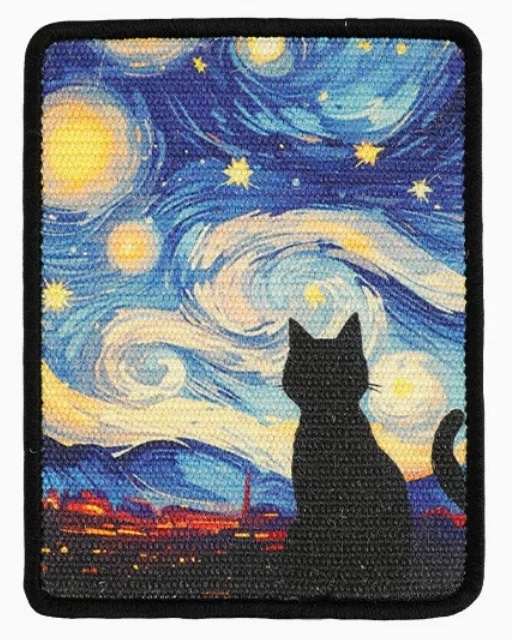
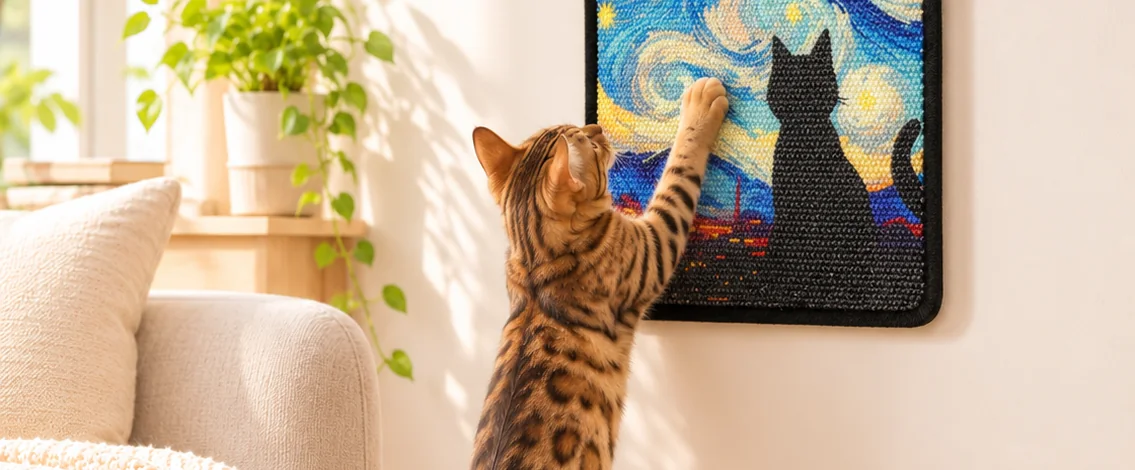
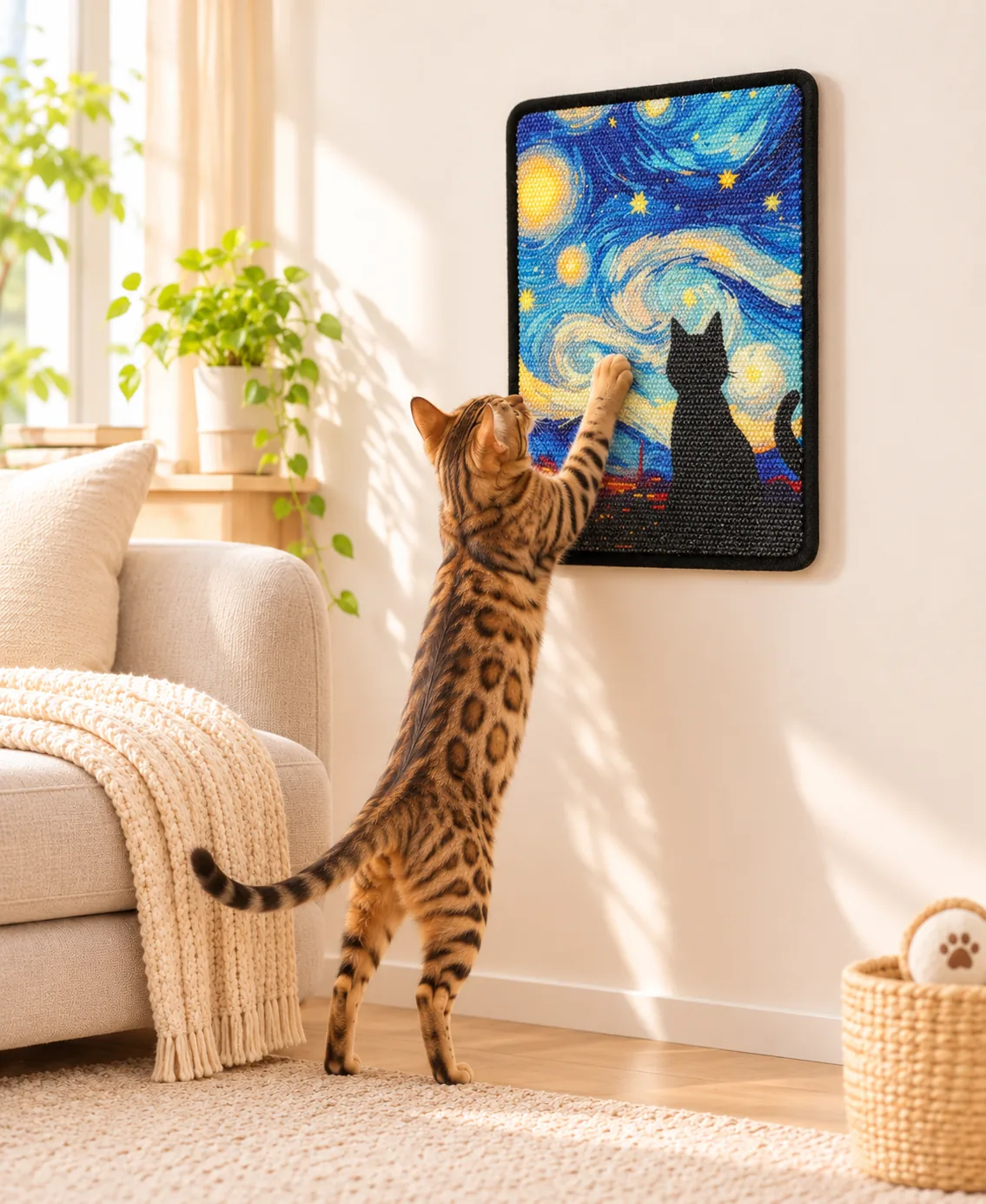
Woven sisal mat is the newest format and the most space-efficient. A woven face on a thin board gives the same claw-catching texture in a flat panel, which means it can be fixed to a wall, the side of a sofa or a cabinet door rather than taking up floor area. This is the format behind Meower’s woven sisal scratching board: a 38 × 30 cm mat that hangs with velcro pads, so nothing is drilled and nothing is left behind when it moves.
Cardboard works, and many cats love it, but pressed-cardboard boards break down under claws and shed flakes. They are cheap to replace — just expect to buy more of them.
Carpet is the one to avoid: it feels like upholstery, which blurs the line between “allowed to scratch” and “not allowed to scratch”.
One practical note: cats are individuals. A cat that ignores sisal rope may use a woven mat, and a cat that ignores both may want a horizontal cardboard tray. Offering two or three formats and watching what gets used is faster than trying to reason it out.
Where to Put It: Next to the Damage, Not in a Corner
Placement is where most scratching setups fail, and it is the cheapest thing to fix.
Put the scratcher beside the piece of furniture the cat is already damaging. Not across the room, not in the hallway, not tucked behind a plant. A cat maintains a scratching spot; if the new surface is not at that spot, it is not competing with the sofa, it is just furniture in a different place.
Then add more. The usual recommendation is one scratcher per cat plus one extra, spread across the rooms the cat actually uses — the living room, the bedroom, the spot by the window. Scratching is a marking behaviour, so a single post in a single room does not cover the territory a cat thinks it owns.
Two details make a difference in practice:
- Height. If the cat scratches the sofa arm, put something at least as tall as the arm right next to it. If it scratches the top corner of a sofa back, you need something taller, or a wall-mounted panel at that height.
- Traffic. Don’t block the route the cat uses to get from one room to another. A scratcher in the middle of a doorway gets avoided; one just to the side of the doorway gets used.
For a wall-mounted option, mounting height should let the cat stretch up and forward without crouching — roughly where the cat’s shoulders sit when it stands on its hind legs, and low enough that it can reach the bottom edge comfortably.
Protecting the Sofa While the Habit Changes
Redirection takes weeks, not days, so the furniture needs temporary protection in the meantime. The goal is to make the sofa arm uninteresting, not to punish the cat.
- Block the spot physically. A throw over the arm, a slipcover, or a sheet of stiff plastic over the corner — the surface has to feel wrong the moment the claws go in.
- Double-sided tape on the damaged corner works on many cats. It is not an aversive: cats simply dislike the tackiness on their paws, and it peels off.
- Move the furniture if you can. Even 30 cm of clearance from the wall removes a favourite corner.
- Trim the claws every one to two weeks to blunt the tips and cut the damage a single pass can do. Ask a vet or groomer to demonstrate the first time; cutting the quick is painful and makes a cat resist handling.
- Make the new surface more interesting than the sofa. Catnip or silver vine rubbed into it, or a toy dragged across it, is often enough to get the first few scratches in — and once a cat has marked a surface, it tends to come back.
What Doesn’t Work (and What to Do Instead)
Punishment. Yelling, tapping the nose, or spraying water may interrupt the behaviour in the moment, but it does not teach the cat where to scratch instead. It teaches the cat not to scratch in front of you, which means the behaviour moves to another room or to the hours you are asleep. It also damages the relationship you need in order to redirect the cat at all.
Declawing. Not a behaviour solution at all — it is abuse. It gets its own section below, because it has to be said plainly.
Repellent sprays on their own. They can support a plan, but they cannot replace providing a surface the cat actually wants to use. Alone, they cover the hole rather than fill it.
And one non-mistake worth knowing: a cat often ignores a brand-new post for a week or two before trying it. Leaving it where it is, rather than moving it around looking for a better spot, is part of the process.
Declawing Is Abuse — Never Do It
Declawing is not a nail trim, a grooming choice or a last resort. It is abuse, and it should not be done under any circumstances.
The procedure is an amputation. Each of a cat’s toes ends in a bone called the third phalanx, and the claw grows out of it; declawing removes that bone, the claw and the surrounding tissue. It has been compared, accurately, to cutting off the last joint of a person’s fingers. Ten toes means ten amputations.
Cats do not walk away from that as if nothing happened. The immediate pain is severe, and for some cats it never fully resolves: chronic paw pain, a permanently altered gait, reluctance to jump or climb, and early arthritis in the affected limbs are all documented outcomes. A cat that can no longer defend itself with its claws is more likely to bite instead. And because digging in the litter tray becomes painful, some cats stop using it — the “solution” creates a new problem inside the house.
The law is moving the same way as the evidence. Declawing is illegal or effectively banned in the United Kingdom, Australia, New Zealand, most of the European Union, Israel and Brazil, and it is banned in parts of Canada. In the United States it is illegal in New York and Maryland, and in a long list of cities. The American Association of Feline Practitioners and the International Society of Feline Medicine oppose it, and the American Veterinary Medical Association discourages it.
No excuse survives contact with the facts. “It’s just the claws” is wrong — a claw is the tip of a toe. “It’s for the furniture” means the sofa is being ranked above a cat’s toes. “The vet will do it” does not make an amputation routine. If a landlord, a partner or anyone else is pressing for the surgery, refuse, and change the scratcher set-up instead — that is what the rest of this guide is for.
Cutting off a cat’s toes is not a solution to a scratched sofa. It is abuse, and there is no version of cat ownership in which it is acceptable.
How to Stop a Cat From Scratching Furniture: A Four-Week Plan
| Week | What to do |
|---|---|
| 1 | Note where the cat scratches and when. Put two scratchers out: one vertical near the damaged furniture, one of a different format in another room the cat uses. |
| 2 | Cover or tape the main damaged spot. Add catnip to the new surfaces. When the cat uses the scratcher, say nothing and let it finish. |
| 3 | Move a scratcher closer to the preferred spot; if the cat still ignores it, change material or orientation, and re-check the height. |
| 4 | Remove the protection from one spot at a time, least-favoured corner first. If the cat goes back to the furniture, re-cover it for another two weeks. |
Most households see the pattern change within three to four weeks. If the cat is scratching itself raw, scratching walls or doors rather than furniture, or if there has been a sudden change in behaviour in an adult cat, that is worth a vet visit rather than a training plan.
Options for Small Apartments and Renters
Floor space is usually the limiting factor. A standard post plus a cardboard tray plus a lounger is a lot of furniture in a one-bedroom flat, which is where wall-mounted scratchers earn their place.
A flat woven panel covers the same claw-catching surface in a fraction of the footprint and can go where the cat already scratches: the hallway wall, the side of a sofa, a cabinet door. Meower’s woven sisal board mounts with four pairs of velcro pads rather than screws, so it can be moved between rooms and comes off without leaving adhesive behind — the practical reason it works in rental homes where drilling is not an option.
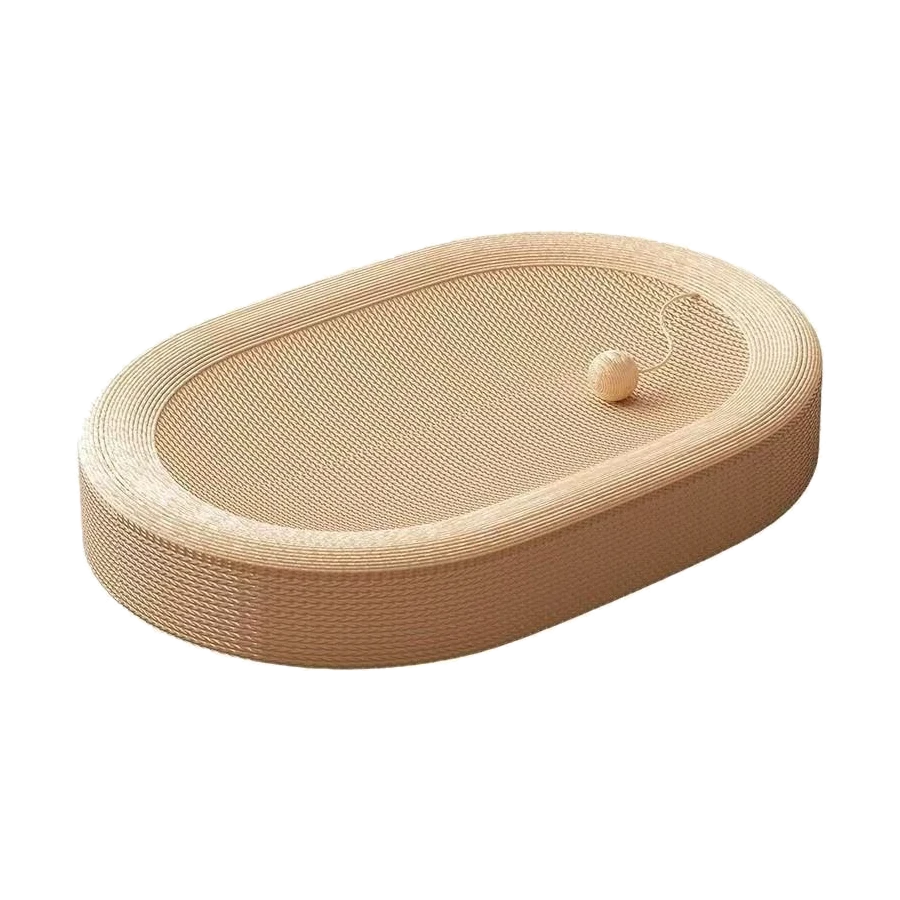
If the cat prefers to lie down straight after scratching, a flat lounger is a better fit than a vertical post. That is the logic behind the sisal rope scratcher and lounger: a 60 × 40 cm surface with a raised rim, long enough to stretch out on and wide enough to turn around on, at 8 cm tall with 600 g of weight so it stays put. Both formats are listed under cat scratching posts.
FAQ
How many scratchers does one cat need?
One per cat plus one extra, spread across the rooms the cat uses. Most “my cat ignores the post” stories involve exactly one post, in a corner, in a room the cat rarely scratches in.
Do cats prefer sisal or cardboard?
It varies by cat, and the honest answer is that you find out by offering both. Sisal holds up better and leaves less mess; cardboard is often more immediately attractive to a cat that has never used a scratcher. Many households end up with one of each.
Does catnip help a cat use a new scratcher?
Often, yes — especially for cats that respond to catnip at all (roughly half to two-thirds do, and the response is inherited). Silver vine is a useful alternative for the cats that do not. Rub it into the surface rather than putting it on the floor beside it.
Can I stop a cat scratching the sofa without declawing?
You have to. Declawing is abuse — it is the amputation of a cat’s toes, not a nail trim — and it is never an acceptable response to scratching. What works is the plan above: a stable surface, at the right height and in the right material, beside the spot the cat is already using; temporary protection on the furniture; and three to four weeks of consistency. If a landlord or anyone else is pushing for the surgery, the answer is still no.
The Short Version
Cats scratch for reasons that have nothing to do with obedience, and they scratch where the household already lives. To move the behaviour off the sofa: put a stable scratcher tall enough for a full stretch right beside the damage, choose a material the claws can catch in (sisal over carpet), protect the furniture for a few weeks, and give the cat one extra surface in another room. Don’t punish, and never declaw: it is abuse, it is illegal in much of the world, and it does not fix the behaviour anyway.
The surfaces you offer are the part you control, so make them easy to use: at the right height, in the right place, and in a material the cat will actually dig into. And if the spot you are protecting is also where the litter tray sits, the air in that corner is worth a look too — how indoor air quality affects your pets covers what accumulates there and what filters can and cannot remove.