Cat litter box smell is almost never just the litter. Three things keep it coming back: waste sitting in the tray, a room that never exchanges its air, and odor that has already soaked into soft furnishings. Deal with them in that order and most apartments stop smelling within a week.
Most shortcuts work against you. Scented litter, plug-in fresheners and “odor eliminator” sprays add fragrance on top of ammonia, which is why a treated box smells like fake flowers and cat urine at once. A purifier helps only with the third problem, and only with the part of the smell it can reach.
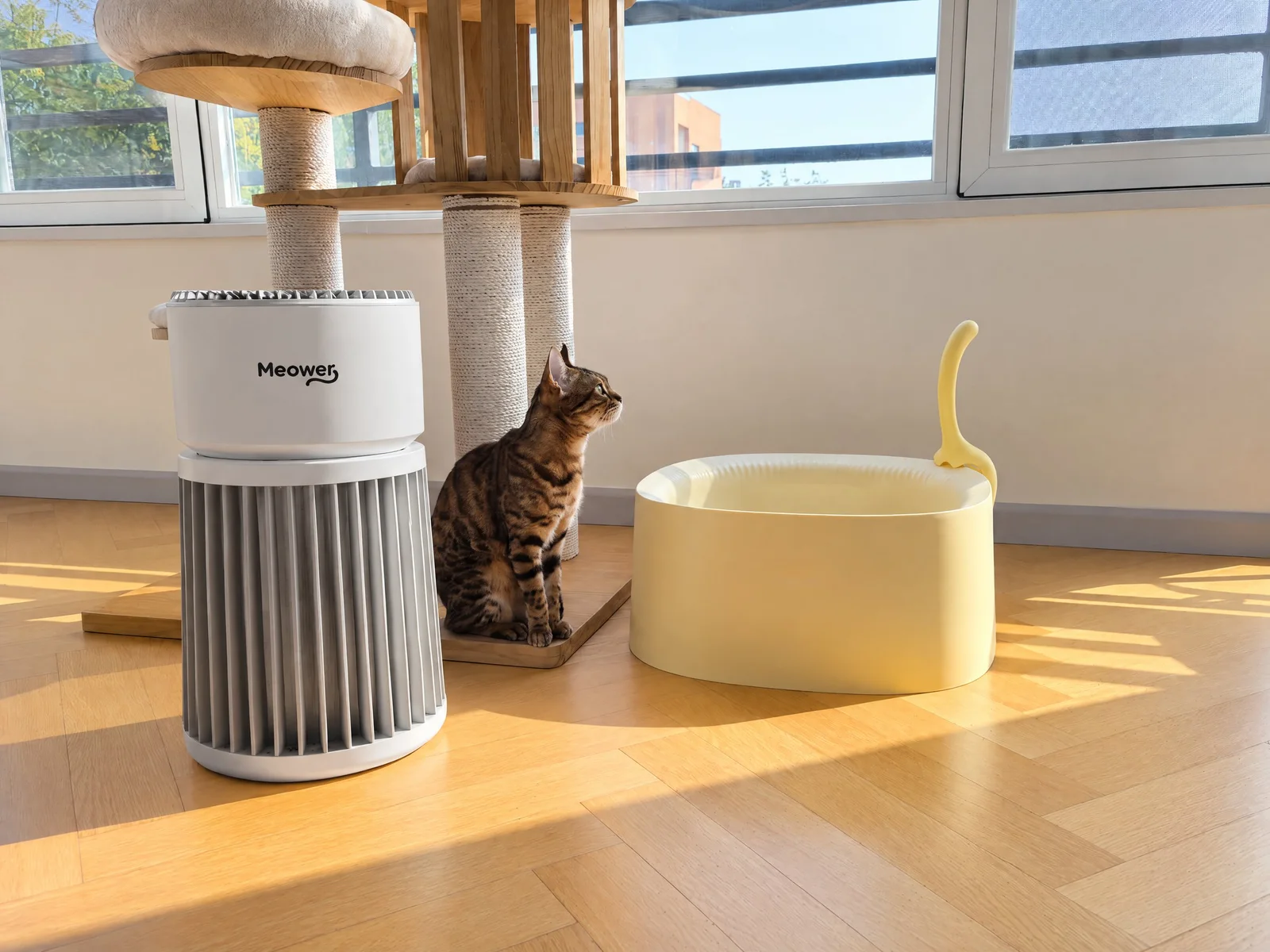
Why Cat Litter Box Smell Spreads Through the Whole Room
Cat urine contains urea, and bacteria in the litter break it down into ammonia within hours — faster in a warm room, which is why a tray that was tolerable at breakfast is sharp by evening.
You are smelling two different things at once:
- Gases. Ammonia, sulfur compounds from feces, and volatile organic compounds from litter and waste. Ammonia is lighter than air and drifts upward; the heavier compounds hang low around the tray. Most of what people call litter box odour is gas, and gas passes straight through a particle filter.
- Particles. Clay dust, tracked litter and cat dander. This is what a HEPA filter is for, and the particles carry odor on their surface as well.
Both spread through air movement: a tray in a warm bathroom with the door shut is a closed system that fills up and leaks under the door. You also stop noticing your own box within half an hour — olfactory adaptation, not cleanliness. Guests get the full picture.
Step 1: Fix What Is in the Tray
Scoop twice a day, not once
One scoop a day is the floor, not the target: a tray cleaned at 8 a.m. has ten hours of deposits in it by early evening. Morning and evening take under a minute each.
Bag the waste and take it out of the room. A full bag in the bathroom bin keeps releasing odor — the classic reason a “clean” box still smells.
Change all the litter, and wash the tray
For clumping litter, replace everything every two to four weeks; for non-clumping, weekly. Wash the tray with unscented soap and warm water, rinse well, and let it dry completely before refilling. Damp litter starts producing ammonia immediately.
Plastic scratches, and the scratches hold bacteria no scoop reaches — the same reason a chopping board keeps a smell after washing. If the corner where the cat urinates still smells after a wash, replace the tray. That is the honest answer to “why does my box still smell after scooping?”
Choose litter for absorption, not for scent
Clumping clay works best for everyday smell, because the urine leaves with the clump instead of sitting in the tray. Crystal (silica) absorbs moisture but holds the urine in place until it is stirred or removed, so ammonia builds under a dry-looking surface. Wood pellets and paper are low-dust and kind to kittens and seniors, but weaker on smell.
Scented litter is the one to skip. It covers ammonia rather than removing it, and a cat that dislikes the smell of its own tray may start urinating somewhere else entirely.
Depth, size and number of trays
The ASPCA’s litter box guidance is one to two inches (2.5–5 cm) of litter for most cats: deeper and the cat sinks, shallower and urine reaches the plastic. The same source lists a box that is too small, a hood, or a liner as reasons a cat may avoid a tray — and a hood traps odor around a cat’s nose as well as yours.
A tray should be about one and a half times the length of the cat, with a low entry for kittens and older cats. One tray per cat plus one extra is the standard rule, and it means trays in different places: a cat reads three trays in a row as one location.
For smell, avoid the smallest and most enclosed spot in the house — a bathroom with no fan is the worst case, not the best. Keep the tray off the radiator and away from the washing machine’s exhaust, in a quiet corner with two exits.
A five-minute routine
| When | What |
|---|---|
| Morning | Scoop solids and clumps, bag them, take the bag out of the room. |
| Evening | Scoop again; check depth and top up. |
| Weekly | Wipe the rim and any hood with unscented soap. |
| Monthly | Full litter change; wash the tray; check for deep scratches. |
Step 2: Move the Air — Ventilation Is Not Optional
A purifier is not ventilation. It recirculates the air already in the room; ventilation takes that air out of the building, which is the part that matters for ammonia.
The tools, in order of effectiveness:
- An exhaust fan that vents outdoors, run while the tray is in use and for 20–30 minutes afterwards.
- A window with a fan blowing out, not in. An open window in still air does very little.
- An open window on its own — better than nothing, and useless as soon as the weather turns.
Apartment problem: why the cat litter smell reaches the rest of the home
Cat litter smell in an apartment is rarely a filtration problem. Air moves through the gap under a closed door, and in a modern block the corridor often sits at a different pressure from the room, so the smell leaves whether you want it to or not. A brush strip on the door and a tray moved away from the doorway do more than a stronger purifier.
The winter trade-off is real: nobody opens a window at -2 °C, but ten minutes twice a day is enough. A room sealed from November to March is why the smell shows up in January and not in June.
Step 3: What a Filter Can and Cannot Do About the Air
The two kinds of pollution in a litter box room need two different filter stages. HEPA media captures particles and does nothing for ammonia: a gas molecule passes straight through. Activated carbon is the stage that takes on gases and odors. The filter-stage explainer in our air purifier guide covers how they work, so the part worth being honest about here is the limit.
Ordinary activated carbon handles the larger odor molecules from litter, cleaning products and waste gas well enough, but ammonia is a small, polar molecule that plain carbon holds less effectively. A domestic carbon stage takes the edge off; it is not a scrubber and cannot compensate for a tray that needs cleaning. “Air purifier for litter box” gets sold as a complete solution when it is a backstop for steps 1 and 2.
What filtration adds once those steps are done: it catches the litter dust and tracked particles that carry odor back into the air every time the cat digs, and keeps them out of bedding beside the tray. If the box sits in the room where the cat sleeps, the difference indoor air quality makes to pets is worth reading next.
Carbon is spent long before the HEPA media looks dirty, and the signal is the smell returning at the exhaust: if you can smell the box while standing at the unit, the carbon is done, whatever the calendar says.
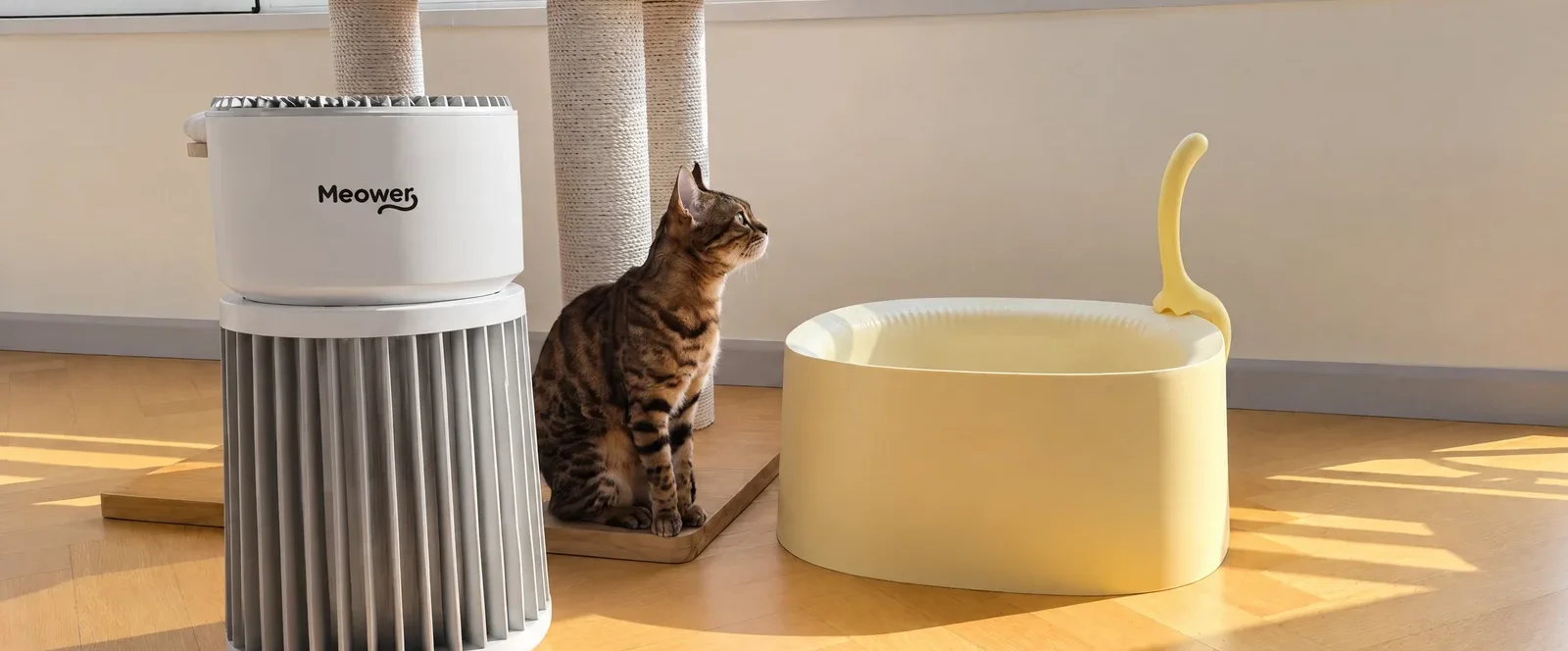
Positioning a purifier in a litter box corner
- Distance: one to two meters from the tray. Directly beside it, the unit re-filters air it has just cleaned.
- Height: on the floor, where the heavier compounds and the litter dust sit.
- Out of the path to the door: if the fan pushes air toward the gap under the door, it is helping the smell leave the room.
What Only Masks the Smell — and What Makes It Worse
- Scented litter and odor-control powders. Fragrance on top of ammonia is still ammonia, and a cat’s nose is far more sensitive than ours: a tray that reeks of perfume is a reason to stop using it.
- Plug-ins, candles and incense. They add their own volatile compounds, and candles add combustion particles. Near a litter box they make a small room worse.
- Essential oil diffusers. Many common oils — tea tree, eucalyptus, citrus, peppermint, pine — are toxic to cats, and cats groom them off their fur and clear them slowly. Keep diffusers out of any room a cat lives in.
- Ozone generators. The EPA’s review is clear that ozone is a respiratory irritant, and that no federal agency has approved ozone generators for use in occupied spaces. They also do nothing about the source.
- Enzyme cleaners in the wrong place. Genuinely useful on accidents outside the box; inside the tray they are just another smell.
Using the MW200 in a Litter Box Corner
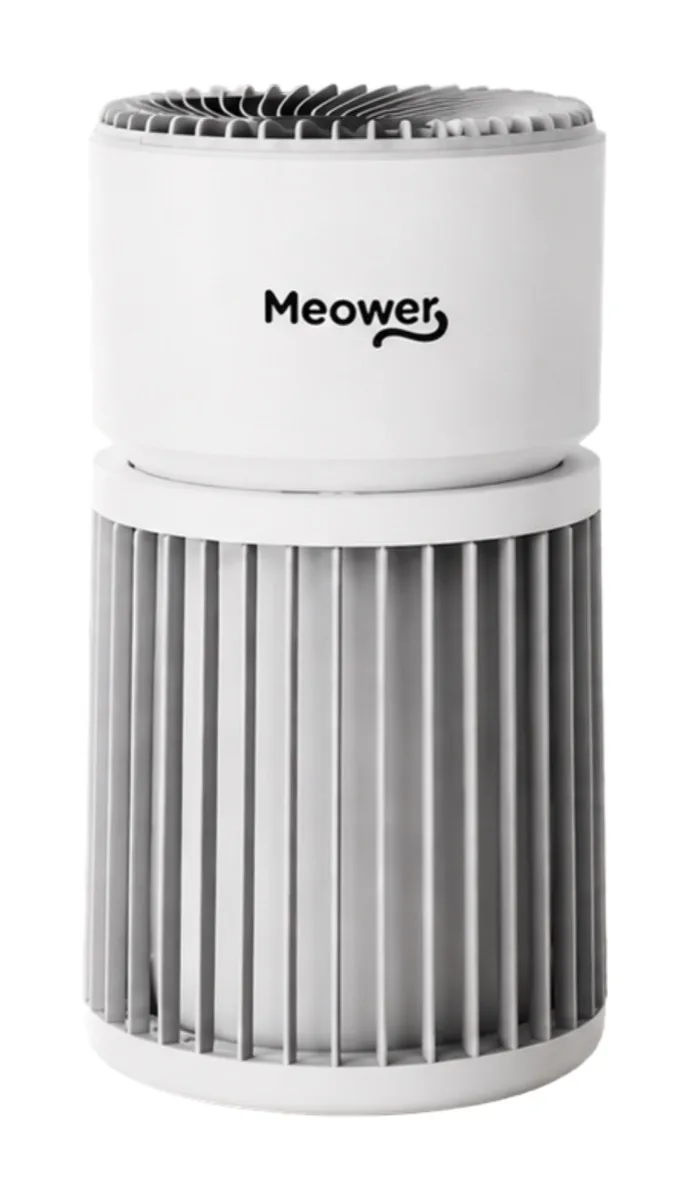
The Meower MW200 is the unit we would put in a room with a litter box, with one caveat: it is the third step, not the first. It brings a 360° intake that pulls air in from every side at floor level, H13 HEPA media for the dust and dander a cat kicks up, and an activated carbon stage for gases, rated at 400 m³/h for rooms of roughly 20–40 m². In practice:
- Placement as above, with nothing blocking the 360° intake.
- Auto mode, running around the clock — at 36–50 dB(A) it is quiet enough to leave on overnight in the next room.
- Replace the filter when the smell comes back, not only on the calendar.
- If the tray is scooped twice a day and the room is ventilated, the purifier’s job gets smaller: it is working on dust and staleness, and can move to wherever the cat actually sleeps.
When Litter Box Smell Is a Vet Problem
Some changes are not an air quality question. See a vet if the smell changes sharply, the cat urinates more often or in smaller amounts, there is blood, it strains, or it suddenly stops using the tray. Cornell’s Feline Health Center sets out the causes — urinary tract disease, cystitis, and in older cats kidney disease, diabetes or arthritis that makes the tray painful to get into.
One emergency worth knowing: a male cat straining with little or no urine, especially with crying or a hard abdomen, may have a urethral obstruction. That is a same-day emergency.
FAQ
Does an air purifier get rid of litter box smell?
It helps with the part that is in the air, and only if it has a real carbon stage — HEPA alone does nothing for ammonia. It cannot fix a tray that needs cleaning, and it does not ventilate.
Why does the box still smell right after I clean it?
One of four things: a scratched tray holding bacteria, litter that went in damp, the waste bag left in the room, or a room that has not exchanged its air. The litter itself is the last suspect.
Is scented litter bad for cats?
It is unnecessary. Scent masks rather than removes, and some cats react by avoiding the tray — which is how a smell problem becomes a floor problem.
How many litter trays do two cats need?
Three, in at least two locations. Two trays side by side count as one place, and a multi-cat household is exactly where a single location fails.
The Short Version
Scoop twice a day and take the waste out of the room. Change all the litter every few weeks; replace a scratched tray. One tray per cat plus one, in different quiet places. Ventilate with an exhaust fan, not a closed door. Skip anything scented or ozone-producing. Then, if the background staleness is still there, add filtration with a real carbon stage and run it continuously.
Next step, if the air is the part left over: see the Meower MW200 air purifier, or browse the air purifier range if you need a unit for a larger living space.
And if the litter box is not the only cat problem in the house, the other common one has a longer answer: how to stop a cat from scratching furniture.